I Quit Chasing Keywords and Switched to Topic Clusters
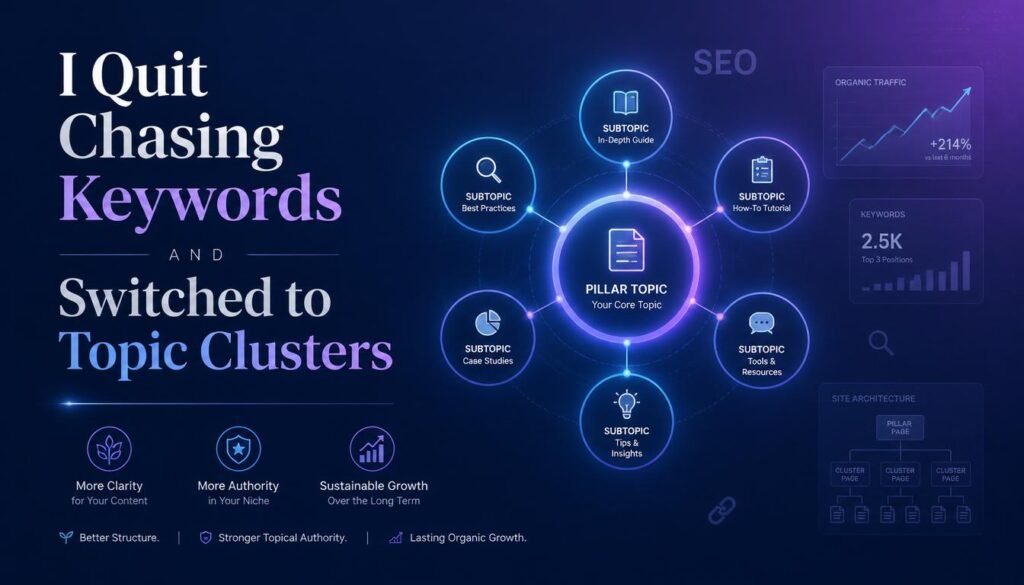
I used to have a spreadsheet. A genuinely enormous spreadsheet, color-coded, sorted by search volume, packed with individual keywords I was hunting one at a time like some obsessive digital forager.
Each week, I’d pick a keyword off that list, write a post specifically targeting it, publish it, and move on to the next one. Rinse, repeat, forever. It felt methodical. It felt like “doing SEO properly.” In hindsight, it was a treadmill that kept me busy without building anything meaningful.
The moment I quit that approach and switched to thinking in topic clusters instead of individual keywords, everything about my blogging process changed, and honestly, improved dramatically. Let me walk you through why chasing individual keywords was quietly sabotaging me, and what shifting my mindset to topics actually looked like in practice.
The Keyword-Chasing Trap I Didn’t Realize I Was In:
Here’s what my process looked like before the shift: open a keyword research tool, find a term with decent search volume and manageable competition, write a post specifically optimized around that one phrase, publish, repeat.
On the surface, this seems reasonable. Keywords matter, after all. People find your content by searching for something specific. But the problem wasn’t caring about keywords, it was treating each one as an isolated target, completely disconnected from any broader understanding of what my audience actually needed.
I was writing to satisfy a search term, not a person. And search engines, it turns out, have gotten remarkably good at telling the difference.
Why Individual Keyword Targeting Started Failing Me:
A few specific problems kept surfacing, the longer I stuck with this approach:
Keyword cannibalization. I’d sometimes write multiple posts that were, functionally, targeting extremely similar search intent, just phrased with slightly different keywords. Instead of these posts reinforcing each other, they often ended up competing against each other in search results, splitting relevance and authority that could have been concentrated into one genuinely strong piece.
Thin, narrowly-focused content. Writing specifically to satisfy one keyword phrase often meant producing content that answered exactly one narrow question and nothing else, even when readers arriving on that page clearly had related follow-up questions I wasn’t addressing.
No sense of topical authority. My blog had dozens of individually keyword-optimized posts, but no coherent signal to search engines that I actually understood any subject deeply. I was hitting individual targets without ever demonstrating genuine expertise across a broader area.
Constant, exhausting research cycles. Because each post was treated as its own isolated project, I never built any compounding efficiency. Every single week, I was starting from scratch, hunting for the next individual keyword rather than working through a pre-mapped plan.
What Changed My Mind: Understanding Search Intent Over Search Terms:
The real turning point wasn’t really about topic clusters specifically, at least not at first. It was realizing that search engines have gotten dramatically better at understanding intent and context, rather than just matching exact keyword phrases.
Modern search algorithms don’t just look for pages containing an exact keyword string. They evaluate whether a page genuinely, comprehensively satisfies what someone searching that term is actually trying to accomplish. A page that narrowly targets one keyword phrase, without addressing the broader context a searcher likely cares about, often underperforms compared to a more comprehensive piece that naturally covers related terms and questions along the way.
Once that reality actually sank in, individual keyword chasing started to feel like optimizing for a system that no longer worked quite the way I’d assumed it did.
Switching to Topic Clusters: What Actually Changed in My Process:
Here’s how my actual workflow shifted once I stopped thinking keyword-first and started thinking topic-first:
- I identified broad topics relevant to my niche, rather than individual search phrases, thinking in terms of subjects my audience genuinely cared about understanding deeply
- I mapped out the full range of subtopics and questions within each broader topic, rather than isolating a single keyword phrase
- I researched keywords within that broader context, using them to inform structure and phrasing rather than dictating the entire content plan
- I built content to comprehensively address the topic, naturally incorporating related terms, questions, and angles rather than narrowly targeting one exact phrase
- I connected related pieces of content deliberately, rather than publishing isolated posts with no relationship to each other
That third step ended up being an important nuance. This wasn’t about abandoning keyword research entirely, keywords still genuinely matter for understanding what language your audience actually uses. The shift was in treating keyword research as an input into a broader topical plan, rather than treating each keyword as its own standalone destination.
A Direct Comparison: Keyword-First vs. Topic-First:
| Aspect Keyword-First Approach Topic-First Approach Starting point An individual search phrase A broader subject area Content depth Often narrow, answering one specific query Comprehensive, addressing related questions naturally Risk of cannibalization High, especially across similar keyword variations Lower, since related content is planned cohesively Search engine signal Isolated relevance for individual terms Broader topical authority across a subject Content planning Reactive, one keyword at a time Proactive, mapped out in advance Long-term efficiency Constant fresh research required Builds a reusable roadmap over time |
Seeing this comparison laid out plainly made it obvious, in hindsight, why my old approach kept producing diminishing returns despite the consistent effort I was putting in.
The Research Process Didn’t Disappear, It Just Changed Order:
I want to be clear about something, because I think it’s a common misunderstanding: switching to topic clusters didn’t mean abandoning keyword research. It meant changing when and how I used it.
Instead of starting with a single keyword and building a post around it in isolation, I now start by mapping a broad topic, then use keyword research to inform the specific language, subtopics, and related questions worth covering within that broader piece, or within the cluster of related pieces supporting it.
This subtle reordering, topic first, keywords as supporting research rather than the primary driver, turned out to be the actual mechanism behind most of the improvement I saw. The keywords were still there. They just stopped dictating the entire structure of my content in isolation.
How This Changed the Actual Writing Experience:
Beyond the technical SEO benefits, something I genuinely didn’t expect was how much this shift improved the actual experience of writing.
Keyword-chasing felt scattered and slightly hollow, if I’m honest. I was writing to satisfy a search algorithm’s interpretation of a phrase, not necessarily to genuinely help a specific reader with a real, complete question. Topic-first writing felt considerably more purposeful. I was building genuine understanding around a subject, addressing real follow-up questions naturally, rather than stopping abruptly the moment I’d technically “covered” a target keyword.
That shift in mindset made the actual writing process more engaging for me too, which, unexpectedly, seemed to translate into content that read more naturally and less like it was engineered purely for search engines.
Avoiding the Opposite Extreme: Topics Without Any Keyword Grounding:
I do want to flag a risk on the other side of this, because it’s one I bumped into briefly during the transition. Thinking purely in broad topics, without any grounding in actual keyword research, risks producing content that, while comprehensive, doesn’t actually match the specific language and phrasing real searchers use.
The balance that worked for me: start with the topic, but use genuine keyword research to make sure the language, structure, and specific questions addressed within that topic actually reflect how real people search, rather than assuming I inherently know the right phrasing just because I understand the subject well.
Common Mistakes I Made During the Transition:
A few missteps worth mentioning, honestly:
I initially chose topics that were still too narrow, essentially just slightly broader versions of my old individual keywords, rather than genuinely comprehensive subject areas.
I underestimated how much upfront planning topic clusters require, compared to the relatively low-effort process of just picking a single keyword off a spreadsheet each week.
I occasionally over-stuffed early cluster content, trying to cram too many related subtopics into single pieces rather than trusting that separate, well-connected pieces could each handle their own specific angle.
Working through these mistakes took a few months of trial and error, but each one sharpened how I approached the next topic cluster I built.
Wrapping Up:
Looking back at that old, color-coded keyword spreadsheet, I don’t think the instinct behind it was wrong, exactly. Keywords do matter. But treating each one as an isolated destination, rather than a piece of a much larger, more coherent topic, kept me busy without actually building anything that compounded in value over time.
If you’re currently stuck on that same keyword treadmill, chasing one isolated phrase after another, I’d genuinely encourage you to zoom out. Identify the broader topics your audience actually cares about, map the related questions and angles worth covering, and let keyword research inform that plan rather than replace it entirely.
It’s a bigger shift in mindset than it might initially sound like, but it’s one I wish I’d made years earlier than I actually did.
FAQs:
1. Does switching to topic clusters mean I should stop doing keyword research entirely?
No, keyword research remains valuable, but its role shifts from dictating individual, isolated content pieces to informing the language, structure, and subtopics within a broader, pre-planned topic area.
2. How do topic clusters help with keyword cannibalization?
By planning related content cohesively in advance, topic clusters reduce the chances of multiple pages unintentionally targeting nearly identical search intent, which is a common cause of cannibalization under a purely keyword-first approach.
3. Is a topic-first approach better for search engine rankings?
Many bloggers and SEO practitioners find it tends to perform better over time, since it aligns more closely with how modern search engines evaluate comprehensive topical relevance and intent, rather than isolated keyword matching.
4. How do I choose the right scope for a topic, avoiding it being too broad or too narrow?
A helpful test is checking whether the topic naturally supports several distinct, non-overlapping subtopics or questions. If it does, it’s likely a good candidate; if it barely supports more than one or two angles, it may be too narrow.
5. Does this approach work for smaller or newer blogs, or only established ones?
It can work well for blogs of any size, and arguably benefits newer blogs particularly, since it helps establish clear topical authority in specific areas rather than competing broadly and thinly across too many unrelated keywords.
6. How long does it typically take to see results after switching to a topic-first strategy?
This varies, but many bloggers notice meaningful shifts over a period of several months, particularly as search engines have time to recognize the deeper, more comprehensive topical coverage being built.